Thank You for All That Was Good Between Us: Transforming the Living Bond with an Ex
Did your ex really waste your time, or did they contribute to who you are today? So many individuals approach the topic of a former partner as someone or something that wasted their best years, without realising that resentment and bitterness keep us tied to an ex far longer than heartfelt gratitude ever could.
So many individuals arrive at a workshop with stories of how terrible their ex was. Sometimes, their agenda in having a constellation is not a genuine attempt to reconcile or to move into a space of gratitude and appreciation. Instead, they want to find a way to ‘get rid of them’, to ‘erase’ them from their history, or to have them move ‘way over there, out of sight’—which is especially challenging when the former partner is a parent to their children.
The reality is that many are yet to accept the invitation to mourn a paradise lost. In our avoidance of feeling what was lost, we often demonise the other to create a false shield against the hurt, the pain, and the disappointment—reforming it instead into bitterness, resentment, and anger.
When individuals arrive at a workshop with a story of how terrible their ex was, I frequently and gently ask the question: ‘So, how long did you choose to stay with this terrible person?’
That question in itself can bring awareness to the choices that were made—perhaps even a persistent choice made almost daily over a period of years. In order to heal any relationship, we must come face to face with our choices and take responsibility for our part. Additionally, it serves us well to look at what it was that kept us there: **- Was it fear of loneliness?
- Were we simply playing out a story from our family of origin?
- Did we stay because we felt that we were not worthy of anything better?
- Did we say ‘yes’ simply because they expressed some love and affection, choosing in that moment to surrender discernment and our own ability to choose? Meaning: ‘I don’t choose; they get to choose.’**
What was our part in all of that? This is the invitation: to face our part in the entire story. So many individuals feel so unloved or unworthy in the first place that they say yes to the first person who comes along and offers some hope of feeling worthy—in which case, the real issue is the nest from which they came, not the relationship they ended up in.
Some of the deeper questions that must be asked and looked at include: Can I allow myself to be more happily partnered than my own parents? **- Was I expecting the other to fulfil the idealised image I had of my first love or the ‘perfect’ parent?
- Was I expecting my partner to give me everything my parents couldn’t?
- Was I fully available, or still entangled with someone or something else?
- Was I simply living out a deep childhood pattern of believing that I need to work for love— one that invariably ended with me always putting the needs of others first?**
We can be tempted to go to great lengths to use a constellation to show us why they couldn’t or wouldn’t, rather than having the willingness to face ourselves and the truth of our choices, our own unconscious entanglements, our hidden feelings, and our own lack of responsibility.
Once we have faced all of that, this is when we can finally turn towards the essential sentence:
‘Thank you for all that was good between us.’
The moment we look at the relationship in the light of consciousness, awareness, and fully taking responsibility for our choices, we can give it a place in our hearts with gratitude. We can acknowledge that the relationship contributed to who we are today—and, where applicable, rewarded us with parenthood.
‘Thank you for all that was good between us’ is not the lofty place of ‘forgiveness’, but rather an equaliser: I came here willingly, I stayed a while, and I am thankful for all that we had, fully taking my part in what happened between us.
Part of this process is having the courage to mourn the paradise lost, facing any attempt we make to defend against this loss through using anger, bitterness, and resentment as a shield. When tears flow, the soul is cleansed.
The Impact on the Children
These movements are especially vital when children are involved. It is unjust for them to pay the price for our anger and resentment, nor are they there to soothe our aching hearts when the other leaves. They need that part of them which belongs to the other parent to be welcomed, seen, honoured, and valued—not to be told, ‘You’re just like your father/mother,’ but rather, ‘Your father is good at that too; you get that from him.’
When we seek to erase or demonise the other parent, we shame the child. That is fully and totally on us—we then become the parent who is (perhaps also) harming the child.
Stepping Into Freedom and Making Space for New Love
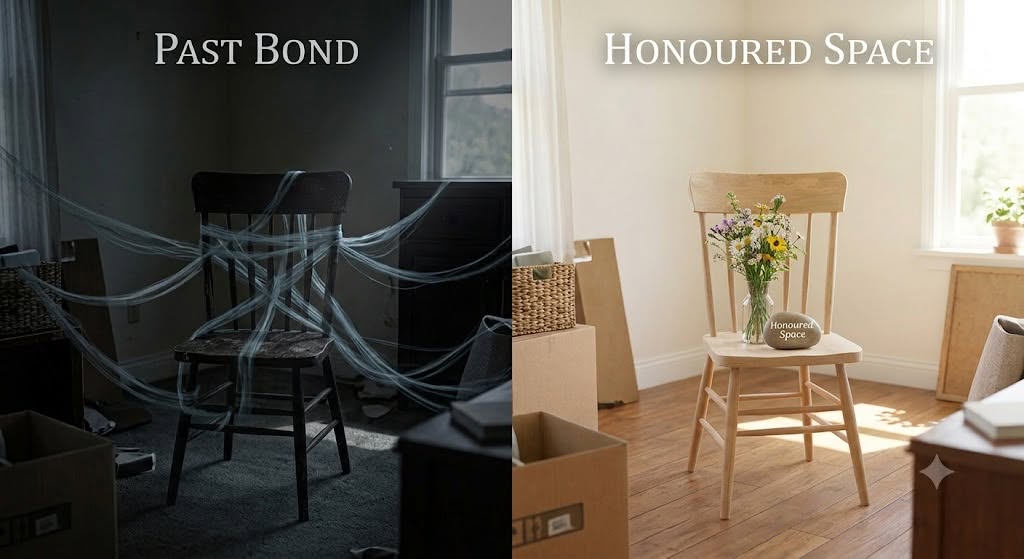
When there is an unacknowledged love, or a love that we have attempted to erase, they occupy an empty chair in our relationship room. This can be felt as a presence, or even a ghost, that a new love must compete with or prove they are better than. This simply leads to yet another cycle: a relationship that buckles under the weight of what remains unhealed, unspoken, and unseen.
When we give our former partners an honoured place in our hearts—free from the weight of anger, resentment, or unspoken longing—we create space for a new invitation. It is an invitation for someone new to enter the room of relationships: a room devoid of ghosts, decorated instead with gratitude, respect, honour, and fondness.
ALL CONTENT © Shavasti (John L. Payne). All rights reserved. You are welcome to freely quote and share this article, provided that full credit and attribution are explicitly given to the author and the original source: Shavasti (John L. Payne) — familyconstellations.net